
Introduction
Have you ever looked at your business books, seen a healthy profit, and still felt something was off? That feeling has a name, and it is called economic profit. Economic profit looks beyond the numbers on your income statement and asks a deeper question. Could your money, time, and effort have earned more somewhere else? This single idea changes how investors, business owners, and economists judge success.
In this guide, you will learn what economic profit is, how it is calculated, and why it matters so much in real business decisions. We will compare it with accounting profit, break down explicit and implicit costs, and show you how companies use this concept to grow smarter. By the end, you will see your business numbers in a completely new light.
What Is Economic Profit?
Economic profit is the amount of money a business earns after subtracting both explicit costs and implicit costs from total revenue. In simple words, it tells you whether your business is truly worth running compared to your next best option.
Think of it this way. If you quit your job to start a bakery, your economic profit is not just the cash you bring in. It also accounts for the salary you gave up and the interest you could have earned by investing your savings instead. If your bakery earns less than what you gave up, your economic profit is negative, even if your bank account shows a gain.
This concept sits at the heart of economic profit theory taught in every business school. It forces you to think like an investor, not just a bookkeeper.
How Is Economic Profit Calculated?
The formula for economic profit is straightforward once you understand the pieces involved.
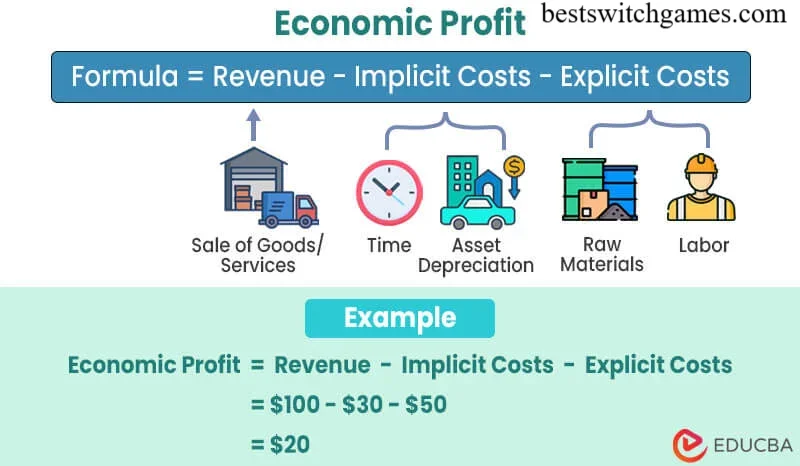
Economic Profit = Total Revenue minus Explicit Costs minus Implicit Costs
Here is a simple breakdown:
- Total Revenue: All the money your business brings in from sales
- Explicit Costs: Direct payments like rent, wages, and materials
- Implicit Costs: The value of opportunities you gave up, such as your own time or unused resources
A Quick Example
Suppose your online store earns 100,000 dollars a year. Your explicit costs, including inventory and marketing, total 60,000 dollars. Your implicit cost, based on the salary you could earn elsewhere, is 30,000 dollars.
Economic Profit = 100,000 minus 60,000 minus 30,000 = 10,000 dollars
That 10,000 dollars tells you the store is genuinely worth your time, since it beats your next best alternative.
What Is the Difference Between Economic Profit and Accounting Profit?
This is one of the most searched questions on this topic, and the answer is simpler than it sounds.
Accounting profit only looks at explicit costs. It is the number you see on tax forms and financial statements. Economic profit goes further and includes implicit costs, giving you a fuller picture of true business performance.
| Factor | Accounting Profit | Economic Profit |
|---|---|---|
| Costs included | Explicit only | Explicit and implicit |
| Used by | Accountants, tax authorities | Economists, investors, strategists |
| Shows | Cash performance | True opportunity based performance |
| Can be negative | Rarely | Often, even with positive accounting profit |
A business can show a strong accounting profit while actually losing money in economic terms. This gap explains why economic profit vs accounting profit is such an important comparison for serious decision makers.
Why Is Economic Profit Important in Business?
Economic profit matters because it answers a question accounting numbers cannot. Are you making the best possible use of your resources?
Here is why this matters so much:
- It reveals hidden costs that traditional profit reports ignore
- It helps investors compare business ideas fairly
- It guides decisions about expansion, closure, or pivoting
- It supports long term strategic planning instead of short term wins
I have seen small business owners celebrate a profitable year on paper, only to realize later that their money and effort would have earned more in a simple investment account. That is the power of thinking in economic profit terms.
Can Economic Profit Be Negative?
Yes, and this happens more often than people expect. Negative economic profit means your business earns less than what you could have earned through your next best alternative, even if your accounting profit looks positive.
For example, a freelancer earning 50,000 dollars a year might feel successful. But if a stable job offer of 65,000 dollars was turned down to freelance, the economic profit is actually negative by 15,000 dollars, once implicit costs are considered.
Negative economic profit does not always mean failure. Sometimes people accept it for freedom, passion, or long term growth potential. Still, it is a signal worth paying attention to.
What Are Explicit and Implicit Costs?
Understanding these two cost types is essential to mastering economic profit.
Explicit Costs
These are direct, out of pocket expenses. They include:
- Rent and utilities
- Employee wages
- Raw materials and inventory
- Marketing and advertising spend
Implicit Costs
These are indirect and often overlooked. They include:
- Salary given up from a previous job
- Interest lost on invested capital
- Use of personal property like a home office
- Time spent that could have been used elsewhere
Implicit costs are the real difference maker in economic profit calculations, since they capture opportunity cost in a way normal accounting simply does not.
How Do Businesses Increase Economic Profit?
Growing economic profit requires more than boosting sales. It means making smarter choices with every resource available.
Consider these proven strategies:
- Reduce implicit costs by using idle assets more effectively
- Focus on high margin products instead of high volume, low margin ones
- Reinvest profits where returns clearly beat alternative options
- Regularly review whether current operations beat other possible uses of capital
- Cut explicit costs without sacrificing quality or customer experience
Businesses that consistently track economic profit tend to make sharper decisions about where to grow and where to pull back.

What Does Zero Economic Profit Mean?
Zero economic profit sounds discouraging, but it actually signals something healthy. It means a business earns exactly enough to cover both its explicit and implicit costs, including the opportunity cost of the owner’s time and capital.
In economic theory, this is called normal profit. It suggests the business is doing just as well as the next best alternative, no better and no worse. Many stable, competitive markets naturally push businesses toward this point over time.
Why Do Economists Use Economic Profit?
Economists rely on economic profit because it reflects true resource efficiency across an entire economy, not just one company’s bank account.
It helps answer bigger questions such as:
- Should capital move into or out of a specific industry
- Are markets competitive or dominated by a few strong players
- Is a business model sustainable in the long run
Since economic profit includes opportunity cost, it gives a more honest signal about whether resources are being used wisely across society.
What Industries Focus Most on Economic Profit?
Some industries pay closer attention to economic profit than others, especially where capital and opportunity cost carry heavy weight.
- Finance and investment firms, where alternative returns are easy to compare
- Real estate, where property value and rental income compete constantly
- Technology startups, where investor capital always has other opportunities
- Consulting and professional services, where personal time has high value
These industries use economic profit analysis to justify decisions that pure accounting profit could never explain clearly.
Advantages and Limitations of Economic Profit Analysis
Like any tool, economic profit has strengths and weaknesses.
Advantages
- Reveals true opportunity cost
- Supports smarter long term decisions
- Helps compare business ideas fairly
- Encourages efficient use of resources
Limitations
- Implicit costs are harder to measure precisely
- Requires estimates that can vary between analysts
- Less useful for tax reporting or daily bookkeeping
- Can feel abstract compared to simple cash numbers
Despite these limitations, economic profit remains one of the most valuable concepts for anyone serious about long term business strategy.
Economic Profit vs Net Income Comparison
Net income, much like accounting profit, only reflects money earned after explicit expenses and taxes. Economic profit goes deeper by weighing that net income against what could have been earned elsewhere.
A company can report strong net income every quarter and still have negative economic profit if its capital could generate better returns through another investment. This is exactly why savvy investors look past net income alone before committing their money.
Conclusion
Economic profit gives you a far more honest picture of business success than accounting numbers alone. It forces you to weigh every dollar and every hour against what else you could have done with them. Whether you run a small shop or manage a large portfolio, thinking in terms of economic profit helps you make sharper, more confident decisions.
Next time you review your business performance, do not stop at the bottom line. Ask yourself what your resources could have earned elsewhere. That single question, rooted in economic profit thinking, might change how you plan your next move.
Do you calculate economic profit in your own business? Share your experience or questions in the comments below.
Frequently Asked Questions
1. What is a simple definition of economic profit? Economic profit is the money left over after subtracting both direct expenses and the value of missed opportunities from total revenue.
2. Is economic profit the same as real profit? Economic profit is often considered more realistic than accounting profit because it includes opportunity cost, giving a fuller view of actual performance.
3. Why does economic profit matter for small businesses? It helps owners see whether their time and money are truly better spent on the business compared to other available options.
4. Can a profitable business have negative economic profit? Yes. A business can show positive accounting profit while still having negative economic profit if implicit costs are high enough.
5. What is normal profit in economics? Normal profit occurs when economic profit equals zero, meaning revenue exactly covers both explicit and implicit costs.
6. How is opportunity cost related to economic profit? Opportunity cost forms the implicit cost portion of the economic profit formula, representing the value of the next best alternative given up.
7. Do large corporations track economic profit? Many large corporations and investment firms track economic profit closely to guide capital allocation and long term strategic planning.
8. Is economic profit used in everyday accounting? No. Everyday accounting relies on accounting profit, while economic profit is mainly used for strategic and economic analysis.
bestswitchgames.com
Email: johanharwen314@gmail.com
Author Name: Hamid Ali
About the Author: Hamid Ali is a business and finance writer who enjoys breaking down complex economic ideas into simple, practical lessons. He writes for students, entrepreneurs, and business owners who want to understand the numbers behind smart decisions.